
Risk Management for EA Traders: How to Protect Your Capital
EAs can trade 24/5 without emotion — but they can also blow accounts if risk isn't managed correctly. These rules protect your capital when you're not watching the screen.
Pipstone Team
Updated February 23, 2026
Why EA Risk Management Is Different from Manual Trading
When you trade manually, your emotions can actually serve as a circuit breaker — if your account is down 20%, you might stop trading and re-evaluate. An EA has no such mechanism. Without explicit risk limits built into your setup, an EA can continue trading through a catastrophic drawdown until your account reaches zero.
This makes risk management for automated trading more critical, not less.
Rule 1: Fixed Risk Per Trade (Not Fixed Lot Size)
Never set a fixed lot size like "0.1 lots per trade" regardless of account size. Instead, risk a fixed percentage of your account balance per trade — typically 0.5–2%.
Formula: Lot size = (Account balance × Risk%) ÷ (Stop loss in pips × pip value)
This means your position size scales with your account — growing when you're profitable and shrinking during drawdowns, which naturally reduces losses in bad periods.
Rule 2: Set an Account-Level Drawdown Limit
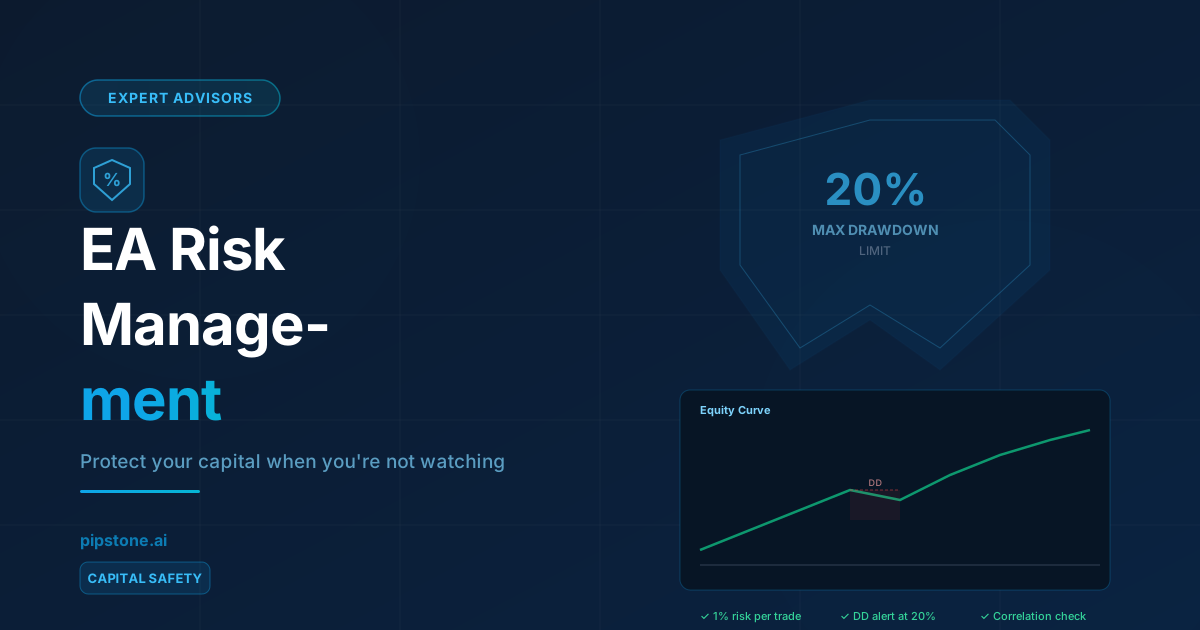
Most EAs don't have a global drawdown shutoff. Set one manually: if your account drops more than 20% from its high-water mark, pause the EA and investigate. This prevents a broken EA or unexpected market condition from wiping the account.
Some brokers (including IC Markets) and third-party tools allow automated alerts or trading halts at specified drawdown thresholds.
Rule 3: Manage Correlation Risk When Running Multiple EAs
Running three EAs all trading EURUSD on the same strategy isn't diversification — it's tripling your risk. True diversification means: different pairs, different timeframes, or different strategy types (trend-following + mean reversion).
Check the correlation between all pairs your EAs trade before going live. Highly correlated pairs (EURUSD and GBPUSD often move together) multiply your exposure in both directions.
Rule 4: Never Run Grid/Martingale EAs on Full Risk
Grid and martingale systems increase lot size after losses, which means a sustained losing streak can generate exponentially large open positions. If you run these strategies, set hard limits: maximum lot size, maximum number of open trades, and a forced close-all trigger at a defined loss level.
Rule 5: Monitor Weekly, Not Daily
Checking your EA's performance every hour creates anxiety and leads to premature deactivation. Review performance weekly. Compare against your expected drawdown range from backtesting. If live performance is within the backtested range — even during a losing streak — the EA is behaving correctly.
Checklist Before Running Any EA Live
- Backtest covers at least 2 years, including 2020 and 2022 volatility
- Max historical drawdown is acceptable (under 30% for most traders)
- Lot size set to risk 1% or less per trade
- Account-level drawdown alert configured at 20%
- EA tested on demo for at least 4 weeks
- No correlation overlap with other running EAs
Ready to start trading smarter?
Get free professional EAs, earn cashback on every lot, and chat with Pip — Pipstone.ai's AI trading assistant. Free to join.