
How AI Is Changing Technical Analysis for Forex Traders in 2026
Technical analysis used to mean staring at charts for hours. AI tools in 2026 can identify patterns, flag key levels, and contextualize your setups in seconds. Here's what's real.
Pipstone Team
Updated February 23, 2026
The Traditional Technical Analysis Problem
Technical analysis has always been partially subjective. Two traders looking at the same chart will often identify different support levels, different trend lines, and different entry signals. This subjectivity means that even experienced traders are inconsistent, and beginners struggle to develop reliable pattern recognition skills.
AI is addressing this in meaningful ways — not by replacing human judgment, but by providing faster, more consistent analysis as a starting point.
Pattern Recognition at Machine Speed
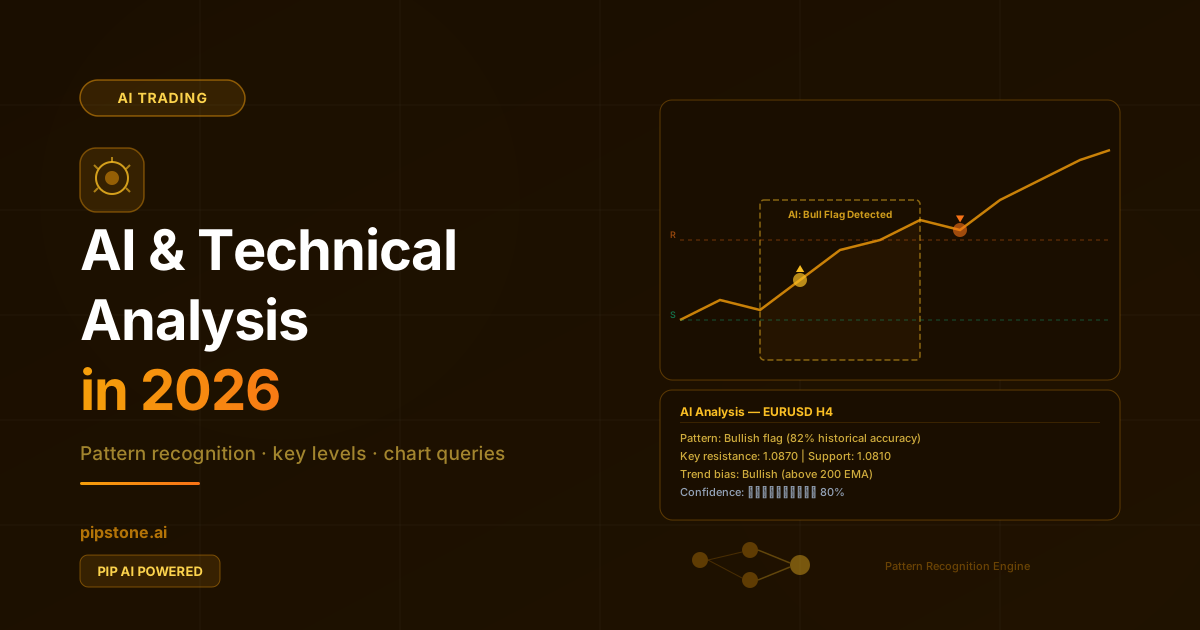
One of the clearest AI applications in technical analysis is automated pattern recognition. Models trained on millions of historical charts can identify head-and-shoulders formations, double tops/bottoms, flag patterns, and wedges with high accuracy — in real time, across hundreds of instruments simultaneously.
What used to take a trader hours of chart scanning can now be filtered and surfaced in seconds. The AI doesn't decide for you — it tells you "here are the 5 charts currently showing a pattern you care about."
Support and Resistance Identification
AI-powered tools can analyze historical price action to identify the most statistically significant support and resistance levels — weighted by the number of times price has touched, respected, or broken through a level. This gives a more objective view of key price zones than hand-drawn lines.
Pip AI on Pipstone.ai uses this approach to surface key levels when you ask about a specific pair — giving you a data-driven starting point rather than guesswork.
Natural Language Chart Queries
Perhaps the most significant shift in 2026 is the ability to query charts in plain English. Instead of manually scrolling through timeframes and drawing tools, you can now ask:
- "Show me where EURUSD has respected this level historically"
- "Is the daily trend bullish or bearish on GBPUSD right now?"
- "What patterns are forming on USDJPY H4?"
AI systems like Pip can synthesize multiple timeframes and give you a coherent technical picture in natural language — the same analysis that used to take 20 minutes of chart work.
What AI Can't Do (Yet)
AI technical analysis tools are not oracles. They excel at pattern identification and historical context, but they cannot account for:
- Fundamental events that break technical patterns (unexpected central bank decisions, geopolitical shocks)
- Market manipulation in less liquid instruments
- Regime changes where historical patterns stop applying
The best use of AI in technical analysis is as a first-pass filter — let the AI identify what's interesting, then apply your own judgment to decide whether to act.
Integrating AI Technical Analysis into Your Workflow
- Use AI to scan for setups that match your criteria across multiple pairs
- Review the AI-identified levels and patterns on your own chart
- Apply your own fundamental context before entering
- Let your EA execute the trade with predefined risk parameters
This human-AI workflow is faster than pure manual analysis and more disciplined than pure automation.
Ready to start trading smarter?
Get free professional EAs, earn cashback on every lot, and chat with Pip — Pipstone.ai's AI trading assistant. Free to join.